
The Library
A brief history of Design World magazine - Part 4
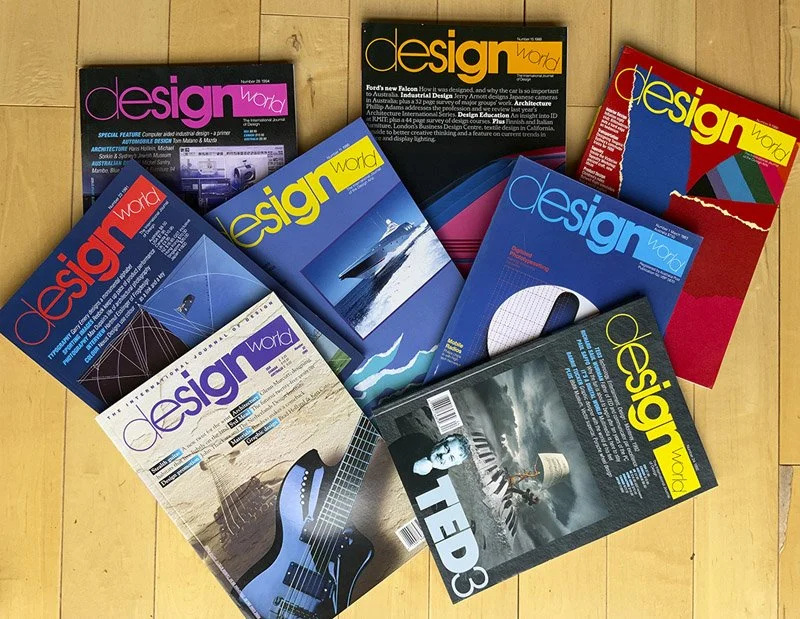
This is part four of a brief history of the activity surrounding Design World magazine.
4: An international perspective …
As our international reputation developed, it became easier to secure interviews with all levels of professional designers, and Australia’s reputation for excellent design grew too. One nice example came from industrial designer John Brown of Design Resource in Sydney. John was invited to Taiwan to discuss/advise on their industrial design program. During discussions it became clear to John that most of their knowledge about Australian design came from the pages of Design World. Nice story.
The year 2000 came as a thunderbolt to all publishers; the internet started to bite. Firstly, print advertising drained away pretty quickly as companies found a way to use this new medium to promote their products. It took a few years for publishers to adjust to very new ways of working. After twenty years, the magazine and general media scene looks very different today. The simpler days of monthly magazines and letters to the editor have disappeared. Newsagents have been reduced to Lotto agencies. Social media has given everyone a voice, whether it’s wanted or not. Things worth talking about have become ‘content’. In fact, anything that demands your attention is called content. I remember in the UK when there was just the BBC, later joined by ITV, black and white television that used just 405 lines. Programs on television and in print media became significant events; the source of the legendary water cooler moments. Now we have streaming, click-bait and binge watching. We don’t share many media events these days. It’s all data, statistics and ‘entertainment’.
The continual developments in public and private communications have led to people leading their lives by looking at a screen; any screen. There is so much ‘content’ (opium of the people) that perhaps there could not be a place for something like Design World. Maybe it came at the right time after all.
I can’t end without a couple of thankyous and some observations. Design World and the industrial design base that it sprang from, owes a debt of gratitude to the designers and their studios who participated in our so-called surveys of current studio activity. We charged a participation fee; we had to, as without that it was impossible to fund. Initially the studios were not used to self-promotion, nor paying for it. But it was all about showcasing their work and I think they appreciated it when they got used to it. I think it did good too.
Design World started out in a suit of clothes borrowed from the UK, the cloth being spun from necessity, scarcity and a welcome serve of altruism. I tried not to let that dampen my optimistic enthusiasm. After all, fashion and design are a way of moving forward, not backwards. As we worked our way through the eighties and nineties, and the world became more international, the affluence of Australia, a largely suburban country, increased. With that affluence came the consumer society with a vengeance. As we gained more and more ‘things’, the less they were valued.
Towards the end of Design World the wannabe design rock star was emerging. Pride in your work is admirable, but excessive pride and hubris (born out of simple ignorance and ego) is unpleasant at best. Alongside that, there were some fundamental aspects of the consumer society that destroy the essence of good design. The American car industry did well when they were committed to redesign every car, every year. Next year’s models appeared before the end of the year, and consumers were urged not to be left behind. Consequently, American auto makers put more effort into changing the look of their cars rather than improving their performance, handling and driveability. I drove quite a lot of American cars during this period, and I can tell they were no models of perfection. In my youth I greatly admired some of Harley Earl’s designs. I still do like the fifties cars as ostentatious works of industrial art. But they were still rubbish to drive enthusiastically.
And so consumerism progressed. Design details became ‘features’, and the whole package became a list of these ‘features’. It wasn’t the Americans that started making well-designed cars; it was the Japanese and the Germans (there are benefits to losing a war when your industry needs rebuilding with modern equipment). These days the design features are more likely to be a list of digital bells and whistles. It is significant that digital design has completely changed what our cars look like and how they are manufactured. Australia’s car industry was about the last to be sacrificed on the alter of becoming an international player, albeit with little purpose. Under these circumstances it is, to me, very surprising that Australia has a large number of clever, talented, creative and innovative designers. I just wish there was more substance for the end products of their labours.
This is now a world when the largest takings at the box office on an opening weekend of a blockbuster movie is valued more than ‘art cinema’ that tells a powerful story or entertains with creativity rather than special effects. It speaks volumes that more is spent on promoting a major movie than is spent on making it.
And, more surprising to me, in some areas design itself has been raised to the level of a religion that should permeate through a company or organisation. Snake oil anyone? My definition of good design is that it is good thinking. Designing is thinking. By all means have designers on the company board, but don’t put non-believers in the stocks. Just do good stuff.
So, could or should Design World have continued? Maybe. It would have needed to evolve like everything else, and that would have been fun too. Next time.eh?
In a postscript I should mention that the large-format Design Ink magazine filled a gap between 1990 and 1993 when I had the opportunity to devote more pages to Australian subjects. Design Ink started to include more articles on what was then known as the digital graphics/desktop publishing revolution. That revolution was soon to become our main focus as it flooded our minds, swept thousands out of their jobs, turned everything upside down, and gave designers personal control (and responsibility) for much more of what they do. It was truly mind expanding, addictive and exhausting. There were no immoveable objects, just irresistible forces. Design Ink was relaunched in a new format as Design Graphics in 1993 and another story began.
The journey continued with the annual Art & Design Education Resource Guide (ADERG); a large-format book that was sent to Careers Advisers at every Australian secondary school. It started life as a special feature in the third edition of Design World in 1983, the last print edition was in 2024. Through it I showcase courses and institutions, and hopefully inspire more students to choose a career in the creative arts.
A sincere and deep-felt thanks to all those who supported Design World, were featured in it, bought it, subscribed to it, and all those who found inspiration in their own life’s journey through design. It was a pleasure, a privilege, and very worthwhile. I still miss Design World.