
The Library
A brief history of Design World magazine - Part 1
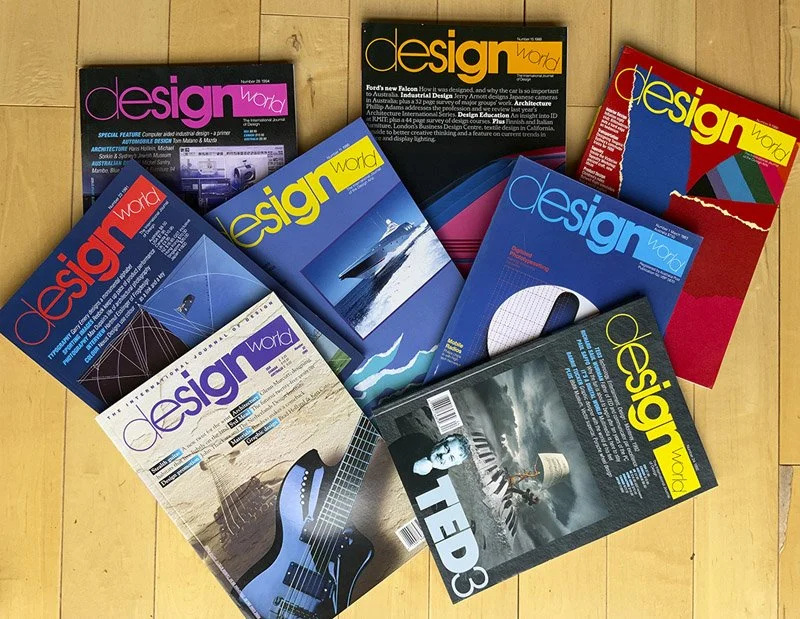
The view from the inside the studio is sometimes quite different from what you see on the outside. That may be the case here. Colin Wood reveals an interesting journey.
This is a brief history of Design World magazine from behind the scenes. The term ‘art & design’ has in recent years been replaced by ‘creative arts’ which usefully broadens the range of subjects it includes. While today’s practitioners work on screens, in the beginning it was pencil and paper. The ‘hi-tech’ of the day was the Rotring technical pen.
1: In the beginning …
I have always been drawn to magazines. One of my favourites was NOVA (1965-1975) that was a leader in editorial design that presented a range of contemporary social issues. It was ostensibly a magazine for women, but it also appealed to some males who lived through the swinging sixties. It combined forceful graphics with important social content. Throughout my teens I was also an avid reader of Design magazine published by the British Design Council. At the time, I was one of a smallish number people who actually knew what an industrial designer did. My school’s careers councillor was perplexed at the very term ‘industrial designer’. In many ways, Design World was inspired by the Design Council magazine and, in Australia, I wanted to publish the sort of design journal that I would want to read. That was very important to me. If I didn’t want to read it, no-one else would either.
From the start, because Design World revolved around several design disciplines I had it mind to have at least three articles that would appeal those who worked in industrial, graphic and interior design. In that way I felt that it would be seen as value for money; worth subscribing to.
At that time, British design benefitted from the observations, critical analysis and writings of a group of journalists who specialised in design commentary. I didn’t have such a group to draw on in Australia, although I was very lucky to have Jenny Towndrow (born in England, educated in Sydney, returned to Australia in 1988) and Anna Griffiths (writer and mother of the actor Rachel Griffiths) writing for me. All praise and thanks!
There are some important aspects of the history of Design World that arose from its roots in the UK, and the period that spawned the underlying premise. The fifties and early sixties in the UK were predicated on the societal and urban renewal that followed WW2. They were the best of times; very exciting with colour and creativity replacing the grey and drab years of the late forties and early fifties. The UK needed to rebuild its industry and social fabric. The UK Design Council was part of the Board of Trade and appeared to have two main aims: to rebuild local industry and to educate the public on the values of good design, in part to enhance the sales of British goods and get the economy moving again.
An important component of British design at this time was imbued with a significant amount of altruism; creating a better, more affluent society for all. Of course, all this happened against the backdrop of the swinging sixties. New manufacturing processes, new attitudes (especially of the evolving teen culture), new colours, greater affluence, the rapid evolution of modern style and decoration, and more adventurous on-location television drama … think The Avengers (not the Marvel superheroes version) using portable cameras and edgy direction. It was a heady mixture.
During the fifties and sixties the Design Council had a coffee shop and display in the Haymarket near Piccadilly Circus which I visited on several occasions (a sort of pilgrimage). At the time, for me, this was as important as visits to the V&A, Britain’s premier museum of art and design over centuries. What a collection! It’s still a magnet for me whenever I’m in London.
Two years after I started Design World in 1983, the impressive John Thackara (a great lateral thinker) became editor of the UK Design Magazine. He did a great job and it was my pleasure to meet him several times. British design had benefitted greatly from its magazine publication. At some point, it was decided to redesign the magazine and give it a larger page size and to refresh its public appeal. The day arrived for the first newly designed edition. John had put the bonnet and grille of a new Alpha Romeo on the cover. Italian! Needless to say, those upstairs were not amused. A few years later it was decided by the Board that the public had been sufficiently educated in the value of good design, the magazine ceased publication and their attention turned to industry who they thought still had a long way to go.
The aforementioned group of design journalists were not just a ‘morning coffee’ group of likeminded people, and their commentary (still seen today in such magazines as Eye) was critical and creative. In addition to the UK Design magazine, I drew inspiration from Blueprint magazine (architecture, design and culture) that copied its page size and currency from Metropolis magazine out of New York. Both of these magazines made everything they reported seem important and worthwhile. Both seemed to have a ‘voice’, a trait I also tried to achieve. While I don’t wish to lapse into carping criticism, and my observations here are limited to occasional encounters, the current crop of Australian design-related magazines seem, to me at least, to be little more than magazines of record. Just ticking boxes.
The history of technology is littered with starts and stops. It seems that once any particular technology matures to a zenith of perfection, something else comes along to take its place. Think telegraph, telephone, newspapers, radio, television, the internet, streaming and so on. Print production has a long and complicated history. In 1983, we were still creating reflection art on layout boards. I was not in a position to do this myself, although I did design every page, in addition to all of the other jobs I did on the magazine. The cavalry arrived in the shape of Peter Sidwell (of the well-known Melbourne family providing pre-press services to almost everyone) of All Graphic Industries. Peter used their then latest phototypesetting and layout system to create the artwork. We were early adopters too, sending the raw text down a phone line at 300 baud rate with a modem that pushed onto a telephone handset. Once again, I couldn’t have published Design World without the help of some of Melbourne’s champions. Big thanks Peter.
The first few years were dreadfully hard work on the artwork front, even with Peter Sidwell’s help. The year 1990 was a watershed for all publishers as we quickly adopted desktop publishing equipment (Apple Macintosh, of course … it cost a king’s ransom at the time). Adobe had recently launched Illustrator 88 and Photoshop courtesy of the Knoll brothers Thomas and John. All magazine publishers converted at the same time, and we all had a lot to learn. There was a steep learning curve for QuarkXPress (this was pre-Adobe InDesign) and Adobe Illustrator and Photoshop, the latter at version 2.5 having no layers and no undo. But the potential advantages were plain to see so we made a big effort and learned a lot very quickly. One big plus was that type sat squarely on the page. No more having to send it back to the art room to have it straightened!