
The Library
A brief history of Design World magazine - Part 3
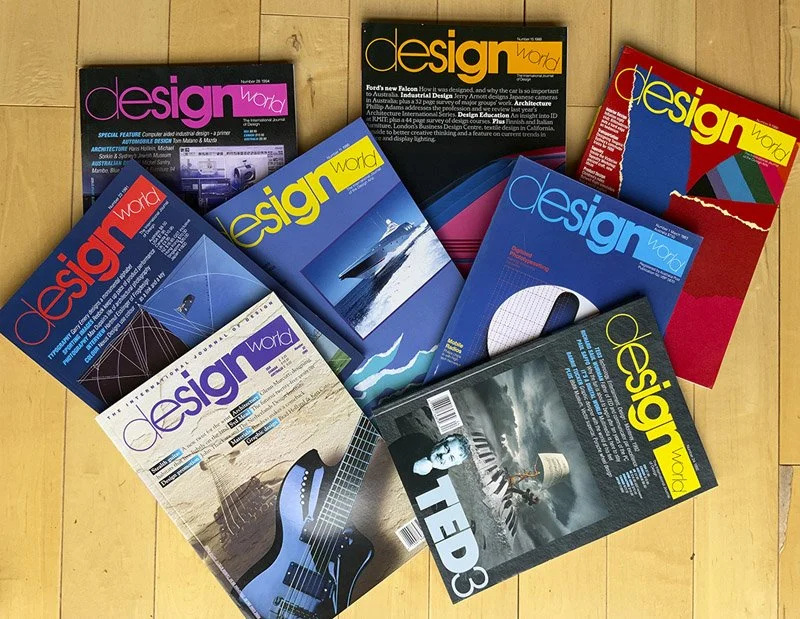
This is part three of a brief history of the activity surrounding Design World magazine.
3: The international picture …
As noted previously, without the Design Arts Board of the Australia Council, Design World wouldn’t have lasted past three or four years.
Then there was the Design Institute of Australia (DIA). Suffice to say here that they failed to interact with us in any meaningful way. They seemed to view Design World as their competitor. Very disappointing.
That Design World lasted fifteen years was due in no small part to the USA. The magazine sales and advertising in Australia alone were insufficient to support the publication. We were on sale in Japan, the UK, New Zealand, Canada, the USA and several other countries. The USA provided the bulk of our sales. At one point, for a couple of years, the American ID magazine had lacklustre management, and Design World outsold the Japanese Axis, the UK Design and the American ID magazine (then Chee Pearlman took over the editorship, upped its game and it flourished … she’s now with TED Conferences).
Getting distributed in Japan was an interesting problem. I had decided that Yohan was my best bet to get distribution in Japan, but they had refused my entreaties. While I was visiting relatives in Montreal, I noticed that Distripress (the international association of magazine distributors) were having a congress in Canada. I suspected that Yohan would be there. I found out the room number of the most senior Yohan person. I phoned him and said I’d like to have Yohan distribute Design World. He said to see him at breakfast the next day. I turned up early, found his table where he was surrounded by his support staff who all looked amazed at the surprise intervention. He studied the copy I gave him and then turned to his staff and said, ‘we will distribute this’. Job done.
From the start I knew that the UK was fully serviced with design journals, but perhaps the USA held potential. As it turned out, America became the lifeblood of Design World and, later, Design Graphics. Strangely the USA, even with its much larger population, was much easier to crack. I had enquired of Austrade about magazine distribution in the USA. How timely, they said. One of our people in San Francisco has just completed a report on magazine distribution in America. You should go and see him.
It turned out that their ‘person’ was American. All the better, I thought, he should know local conditions, so went to the Austrade office in San Francisco on Union Square. The meeting didn’t turn up much apart from him enquiring if I could find him a job in Australia. His report stated that all of the main magazine distributors were on the West Coast. That sounded hopeful, as that was where I was; except that they weren’t. They were on the East Coast. In fact his entire report was filled with errors from start to finish.
So I made my way to New York and the offices of Eastern News (part of the Hearst Corporation). What a stroke of luck … I was introduced to Lisa Scott; the best in the business and such a welcoming person. I had to wait a nervous three days while they considered my potential. I was thrilled when they agreed to distribute Design World and so began a fruitful fifteen year relationship (I still have the baseball bat pen that we signed the contract with). I celebrated with a hamburger at the Hard Rock Café at 221 West 57th Street in New York City (now closed at that address) surrounded by guitars. I was very comfortable with that. Lisa and her assistant Barbara were easy to work with and did wonders. I was so pleased with them I was sure they could do even better. On one trip I sort of complained that our sell-through was only 75%. They were horrified, explaining that the average sell-through was thirty percent, rising to fifty percent if you were doing really well. Put a sock in it Colin, I thought.
On the subject of TED Conferences, Design World gave me an introduction to Richard Saul Wurman. Richard staged six TED Conferences (at the time very exclusive, I attended three) before Richard then sold it to British publisher Chris Anderson who widened the scope and changed it to the current format. At Richard’s conferences, there were more Nobel Prize winners and top CEOs than I had ever seen in one place; plus Kai Krauss, Herbie Hancock and many other luminaries … exclusive on every level.
I once asked Richard how he managed to get so many high flyers to speak at a TED conference, especially as he didn’t pay them a fee. ‘I ask them. They can only say no’, came the reply. Confidence pays dividends!
After the Kobe TED conference, we accompanied Richard and his band of young, mainly American, interpreters back to Tokyo on the Shinkansen bullet train and were invited out to dinner with them. The evening went well until it came to paying the bill; they didn’t take American Express. Richard was distraught. Fortunately I was able to lend him one thousand American dollars which he paid back early the next morning before leaving town. Traveller’s cheques have some advantages.
Design World spawned other things too. On the home front, after starting the publication in a recession in 1983, another one came along at the end of the eighties. Advertising dropped away, partly I thought because Design World had international distribution even though this didn’t detract from the local distribution. Thus Design Ink magazine was born; only distributed in Australia. As Blueprint had ‘borrowed’ their format from Metropolis, so I borrowed from Blueprint. I coveted their use of the Compacta font family (designed for Letraset when they noticed art directors were using very tight letter spacing in their headlines) but had to settle for another of my favourites, Futura Extra Bold. It’s sometimes hard to find your own style if you are influenced by another. For instance, in the eighties, the UK Design magazine used a cover-to-cover editorial page design that became known as their ‘Dymo’ style. Very eye-catching and distinctive. Hard to forget.
In London I got to know Jeremy Myerson. Among his many credits, he was the founding editor of Design Week published by Centaur Media where he worked. I once spent a day with Jeremy trudging through the streets of New York City on a very hot day visiting open studios during an IDSA (or was it ICSID?) conference. When I met Jeremy again at the Royal College of Art in London where he is Professor Emeritus and Founder of the Helen Hamlyn Centre for Design, he told me that he had proposed starting Design Week to Centaur inspired by my starting Design World. Although he did bemoan the fact that Centaur still owned the title after he left, whereas I had no such problem. In any case, no further accolade is necessary. Jeremy is certainly one of the best and most talented in his field.