
One day Australia will need a new flag
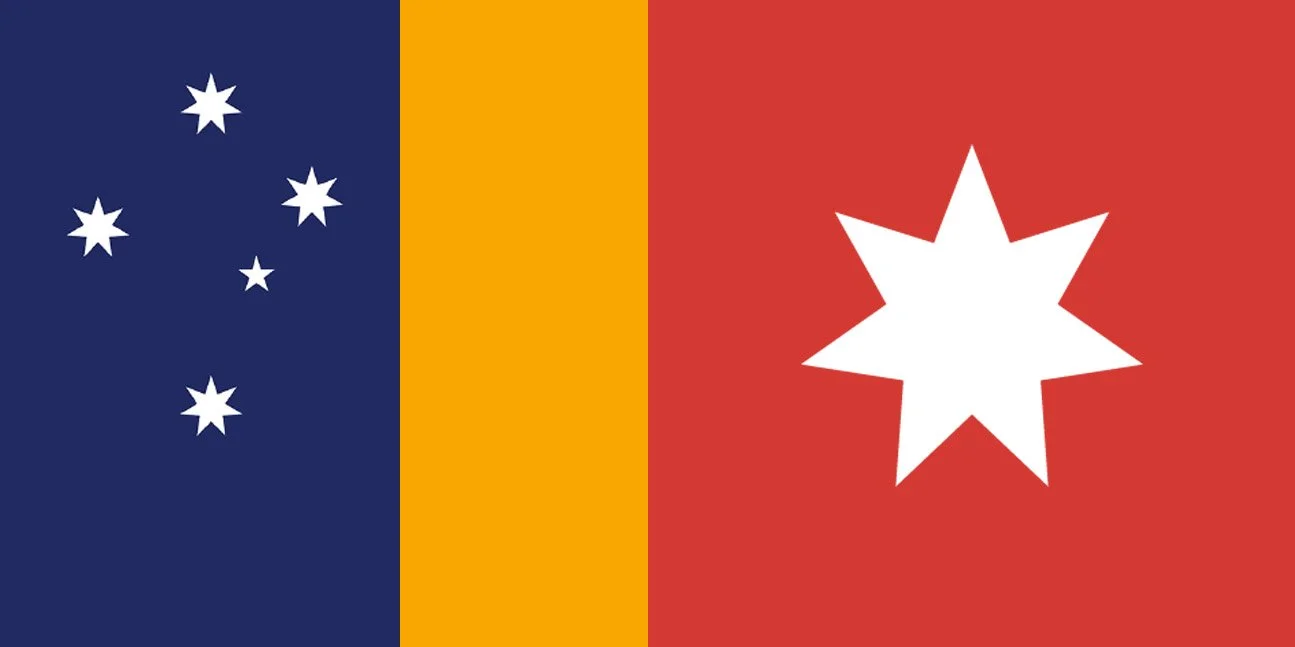
Australia has been nervous and divided on the possibility of changing the national flag. Such a change is closely connected to when or whether Australia will become a republic. I do not belong to either camp, nor do I advocate change. As it stands. I am quite happy with the country being a constitutional monarchy for the time being. But if there is a groundswell of opinion to change to being a republic, I assume that will happen after a great deal of discussion. That is not my focus in this piece. My concern is more about the graphic identity of the country; the flag.
In the run-up to the 1999 republic referendum after which the status quo prevailed, several new flag designs were run up various flagpole. Most designs contained the usual mixture of symbols: kangaroos, boomerangs, stars and maps. There were some attempts to include First Nation symbols and colours, but in such cases it seemed difficult to pay homage to the past while designing something for the future. For me, green and gold don’t hold enough dynamism, nor do they stand proud enough in a crowd.
It seems to me that Australia possibly settled on green and gold (or earlier Blue and gold) as it was a case of ‘anything as long as it’s not red, white and blue’. Given that many countries use red, white and blue, it might be a big ask not to veer towards them. But the combination is compelling. Red for being bold and not afraid to stand out, blue for loyalty and steadfastness, and white for honesty.
Australian international sports teams have adopted green and gold which, in itself, is at odds with the country’s national colours. Ideally, they should be the same, and even that can be difficult given that the sports teams themselves have alternative strip for various reasons from time to time.
In my opinion, one off the best national flags is from Canada. Unique and easily the most distinctive, it is also just two colours (red and white) and features a maple leaf, something no other country includes.
A national flag has to look distinctive when surrounded by other country’s flags. At the other end of the scale, the national colours should look good as bunting for national celebrations. Streets festooned with flags and bunting should be appropriate for national holidays, sports events and so on.
Colours carry sublime messages so, although flags don’t carry a user manual, they do nevertheless speak volumes. Here is a quick summary of the intrinsic meanings I see in my flag.
• The red square represents the land; from the Red Centre to the 34,000km coastline.
A bold statement. We’re proud of who we are. The seven pointed Commonwealth Star represents the six states and combined territories which constitute the nation.
• The gold stripe represents the coastline of the nation, most of whose people live nearby.
• The blue stripe represents the sky and the oceans. The Southern Cross relates to the sky above, under which we all live. The stars emphasise our location on planet Earth. Blue is also for the oceans and seas that surround Australia completely. An island nation indeed.
• The white stars are predominant and stand out from the other colours. The stars are the only white elements.
For the geometrically minded the proportions are:
Red: a square 1:1
Blue: a Golden Ratio rectangle 1:1.618
Gold: a Golden Ratio rectangle with a square on top. 1:2.618
The overall proportions of the flag are the standard 1:2.
Colin Wood